
Cecily test-drove a new crossover last week and came back genuinely unsure about the noises it had made at her. Some of the beeps felt like real warnings, she said, and others felt like the car simply nagging her for no reason she could name. She could not tell the two apart, and the salesperson's quick answer ("that's the ADAS package") did nothing to settle it. The window sticker had promised a suite of driver-assist features, yet nobody had explained which ones merely chirp and which ones actually take the wheel or the brakes.
That gap is the whole problem. Dealerships throw around acronyms and trademarked names, and buyers nod along without knowing whether they are paying for a feature that brakes the car or one that just beeps. ADAS stands for Advanced Driver Assistance Systems, and it is an umbrella term covering a dozen different technologies that range from genuinely useful to mildly annoying.
So let me walk through the main ones the way I wish someone had walked Cecily through them. We will define each feature, look at a real driving moment where it kicks in, and clear up the myth that usually trails behind it.
Adaptive Cruise Control: Cruise That Watches Traffic
Old cruise control held one speed and one speed only. If the truck ahead slowed down, you slowed down yourself or rear-ended it. Adaptive cruise control (often shortened to ACC) adds a radar or camera that watches the vehicle in front and keeps a set gap automatically.
Here is the concrete version. You set it to 70 on the interstate. Traffic bunches up near an exit, the car ahead drops to 50, and your car eases off the throttle and follows at 50 without you touching a thing. When the lane clears, it accelerates back to 70 on its own.
The myth I hear most is that adaptive cruise means the car drives itself. It does not. ACC manages your speed and following distance, but it will not steer, and many systems hand control back to you abruptly in heavy stop-and-go or when the camera gets blinded by low sun. You are still the driver.
"Adaptive" cruise reacts to traffic ahead. "Standard" cruise holds a fixed speed and ignores everything in front of you. If the sticker just says "cruise control," assume the older, simpler kind.
Lane-Keep Assist vs. Lane Departure Warning
These two get lumped together, and they are not the same thing. Lane departure warning watches the painted lines and alerts you when you wander, usually with a beep or a vibration in the seat or wheel. It does nothing to the car. It just taps you on the shoulder.
Lane-keep assist goes a step further and applies a gentle steering correction to nudge you back toward center. That is the system that would have startled Cecily on her on-ramp. On a long highway stretch it feels like a light hand resting on the wheel, smoothing out your drift.
The common mistake is assuming lane-keep will hold the car in the lane while you check your phone. It will not, and it is not designed to. Most systems nag you to keep your hands on the wheel, and they give up entirely on faded paint, tight curves, or snow-covered roads. Treat it as a backstop for a momentary lapse, not a substitute for paying attention.
A note on naming
Every automaker brands these differently. One calls it "Lane Tracing," another "Steering Assist," another "Lane Centering." When a salesperson rattles off a trademarked name, ask the plain question: does it warn me, or does it steer? That single answer tells you which bucket you are in.
Automatic Emergency Braking: The One That Matters Most
If I could talk a buyer into caring about exactly one ADAS feature, it would be this one. Automatic emergency braking (AEB) uses forward sensors to detect an imminent collision and slams on the brakes if you do not react in time.
Picture a kid darting out from between parked cars, or the sedan ahead of you stopping short while you glance at the radio. AEB can shave off speed in the fraction of a second before impact, and sometimes it stops the car entirely. Even when it cannot prevent the crash, lowering the speed at impact changes everything about the outcome.
The myth here is that AEB makes you crash-proof. It does not. It struggles with cross-traffic, pedestrians at night, and oddly shaped obstacles, and it can occasionally trigger when it should not. It is a safety net with holes in it, which is still far better than no net at all.
Many newer cars include AEB as standard equipment. If you are cross-shopping two trims, the one that bundles automatic emergency braking and forward collision warning is usually the smarter buy, even over flashier convenience features.
Blind-Spot and Cross-Traffic Alerts
Blind-spot monitoring puts a small light in or near your side mirror when a vehicle is sitting in the zone you cannot easily see. Some versions also buzz or tug the wheel if you signal a lane change while someone is there.
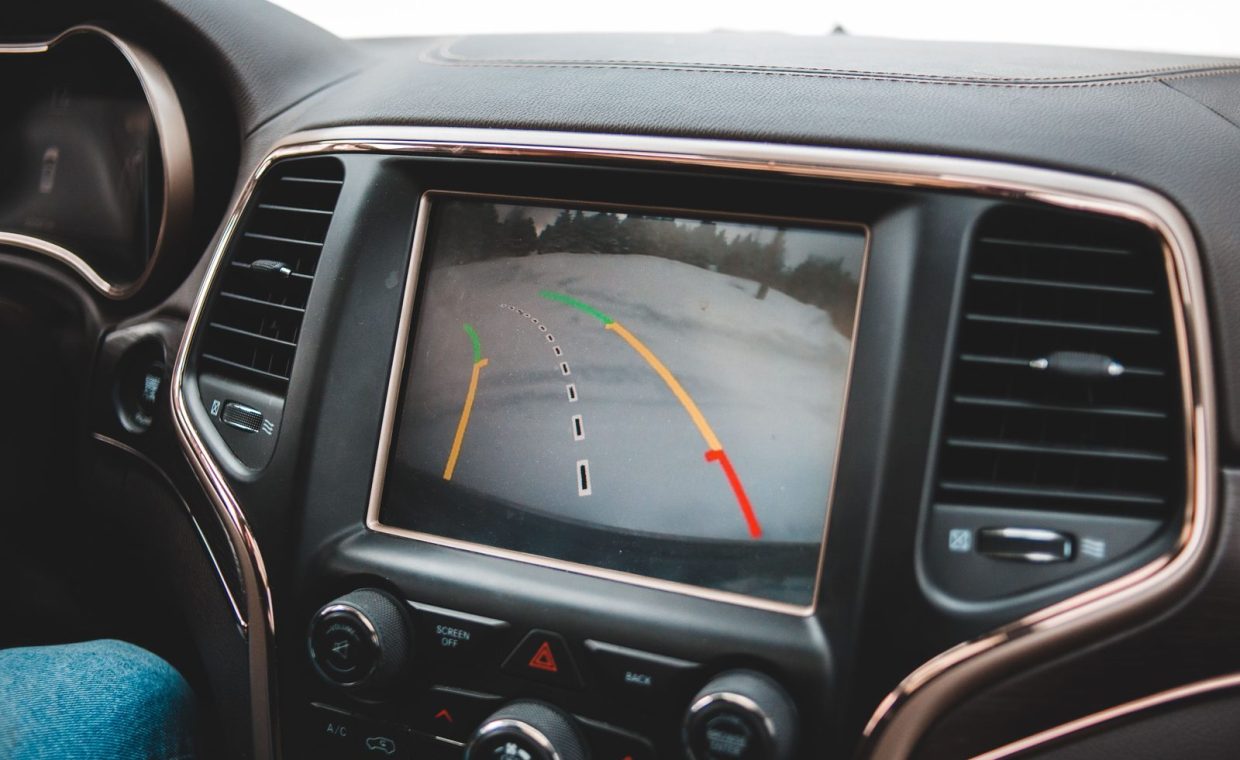
The real-world moment is the merge you do a hundred times a week. You glance, the mirror light is lit, and you wait the extra second instead of drifting into a car you never spotted. Rear cross-traffic alert is the parking-lot cousin: it warns you when something is coming as you back out of a space with your view blocked by tall SUVs on either side.
People often dismiss this as a gimmick, but I think it earns its keep on busy roads. I dug into whether the feature is worth paying extra for in a separate piece on whether blind-spot monitoring is worth the upgrade, and the short version is that it depends heavily on how and where you drive.
The Camera and Sensor Hardware Behind It All
None of this magic happens without hardware. Most systems lean on some combination of a forward-facing camera mounted near the rearview mirror, radar units tucked behind the badge or bumper, and ultrasonic sensors around the body for low-speed parking.
This matters for ownership, not just shopping. A cracked windshield on an ADAS car often needs recalibration after replacement, because the camera lives right behind the glass. A bumper repair can knock a radar sensor out of alignment. These are real costs that did not exist on a car from fifteen years ago.
If a sensor gets blocked by mud, ice, or a sticker, the system disables itself and throws a dashboard message. Wipe the camera and radar areas clean before you rely on these features in bad weather. A caked-over sensor is a system that is no longer watching the road for you.
It is also worth knowing that ADAS hardware overlaps with the cameras some people add separately. If you are weighing a dedicated recorder on top of your car's built-in tech, I broke down the tradeoffs in a guide to choosing the right dash cam for your needs, since the two serve different jobs.
ADAS on Electric Cars: Same Idea, Different Wrapper
EV makers tend to market their driver-assist suites aggressively, and the names get especially confusing here. Underneath the branding, though, an electric car's lane-keep and adaptive cruise work on the same principles as any gas car's. The cameras and radar do not care what is spinning the wheels.
What does differ is how the systems blend with regenerative braking and instant torque, which can make adaptive cruise feel smoother or jerkier depending on tuning. New EV owners already juggle a lot of unfamiliar tech, and if the charging side of that learning curve has you uneasy, our explainer on what range anxiety actually is and how to manage it tackles the worry that usually overshadows everything else.
ADAS is not one feature, it is a category. Some pieces only warn you (lane departure, blind-spot lights), some take action (lane-keep steering, automatic emergency braking, adaptive cruise), and none of them drive the car for you. Buy for the ones that prevent crashes first, convenience second.
How to Read an ADAS Window Sticker Without Getting Lost
When you are standing on the lot, ignore the trademarked names for a minute and sort every listed feature into three plain questions. Does it warn me, does it act on the car, or does it just make driving easier? Almost everything fits one of those.
Then ask the salesperson to demonstrate the two that matter most: automatic emergency braking and lane-keep. A short test drive tells you more than a spec sheet, because you will feel whether the steering nudge is reassuring or irritating to you personally. That is exactly the clarity Cecily was missing when she could not separate the warnings from the nags.
| Feature | What it does | Common myth |
|---|---|---|
| Adaptive cruise control | Holds speed and a set gap to traffic ahead | That it steers or "self-drives" |
| Lane departure warning | Alerts you when you drift over a line | That it corrects the car (it doesn't) |
| Lane-keep assist | Nudges the wheel back toward center | That you can let go and stop watching |
| Automatic emergency braking | Brakes hard to avoid or soften a crash | That it makes the car crash-proof |
| Blind-spot monitoring | Flags vehicles beside you before a lane change | That it replaces a shoulder check |
Does ADAS mean my car is self-driving?
No. These are assistance systems that help with specific tasks like braking, speed, and lane position. Every one of them assumes you are awake, attentive, and ready to take over instantly. None of them are designed to drive without you.
Can I turn these features off if they annoy me?
Most of them, yes. Lane-keep, lane departure warning, and the audible alerts can usually be toggled in the settings menu, though some reset to on each time you start the car. Automatic emergency braking often cannot be fully disabled, and honestly, that is the one you want active anyway.
Why do these systems cost more to repair?
The cameras and radar that power ADAS are mounted in the windshield and bumpers, so a glass replacement or a fender repair can require recalibration to aim the sensors correctly. Budget for that extra step when you get bodywork done on a newer car.
So here is what I told Cecily before she went back to that crossover. Pull up the car's settings menu and the owner's manual together, and make a two-column list: features that only beep at you, and features that actually move the wheel or the brakes. Then test the second column on the same on-ramp and parking lot you use every day, because a lane-keep nudge that feels reassuring at 65 on a wide highway can feel like a tug-of-war on a tight cloverleaf. Once you can name which system made each sound, the beeps stop being noise and start being information, and that is the whole point.