
A few winters back, a friend of mine slid on black ice coming off a highway ramp in a base-model sedan. She walked away with a sore neck and a totaled car. The insurance adjuster, a guy who has seen thousands of wrecks, told her something that stuck with me. He said the difference between her walking away and a much worse day came down to two things she never thought about at the dealership: the structure of the car and the airbags that fired in the right order.
That conversation is why I get a little impatient with option sheets. Manufacturers love to bundle ten acronyms together and charge you a thousand dollars for the "Safety Plus Package," and most buyers nod along without knowing which of those acronyms would actually matter at 50 mph.
So I sat down and ranked the safety tech that genuinely earns its keep when metal meets metal. Some of it is unglamorous. Some of it you cannot even see. But every item here changes your odds in a real collision, and I'll tell you plainly why.
1. Automatic Emergency Braking
If I could only keep one feature on this list, this is the one. Automatic emergency braking (AEB) uses a forward camera, and often radar, to spot a stopped car or a person in your path. When you don't react, it slams the brakes for you.
The reason it ranks first is simple math. A crash you avoid entirely beats any airbag. And AEB is best at preventing the exact wreck that happens most: the low-speed rear-ender in stop-and-go traffic, where a distracted driver looks up too late.
It is not magic, though. AEB struggles in heavy rain, with cross-traffic, and at very high speeds. Treat it as a backstop for the half-second you blink, not a license to tune out. People who lean on these systems get into a specific kind of trouble, which I unpack in our piece on the false sense of security driver-assist features create.
Every other feature here helps you survive a crash. AEB is the only one whose whole job is to make sure the crash never happens in the first place.
2. The Crash Structure You Cannot See
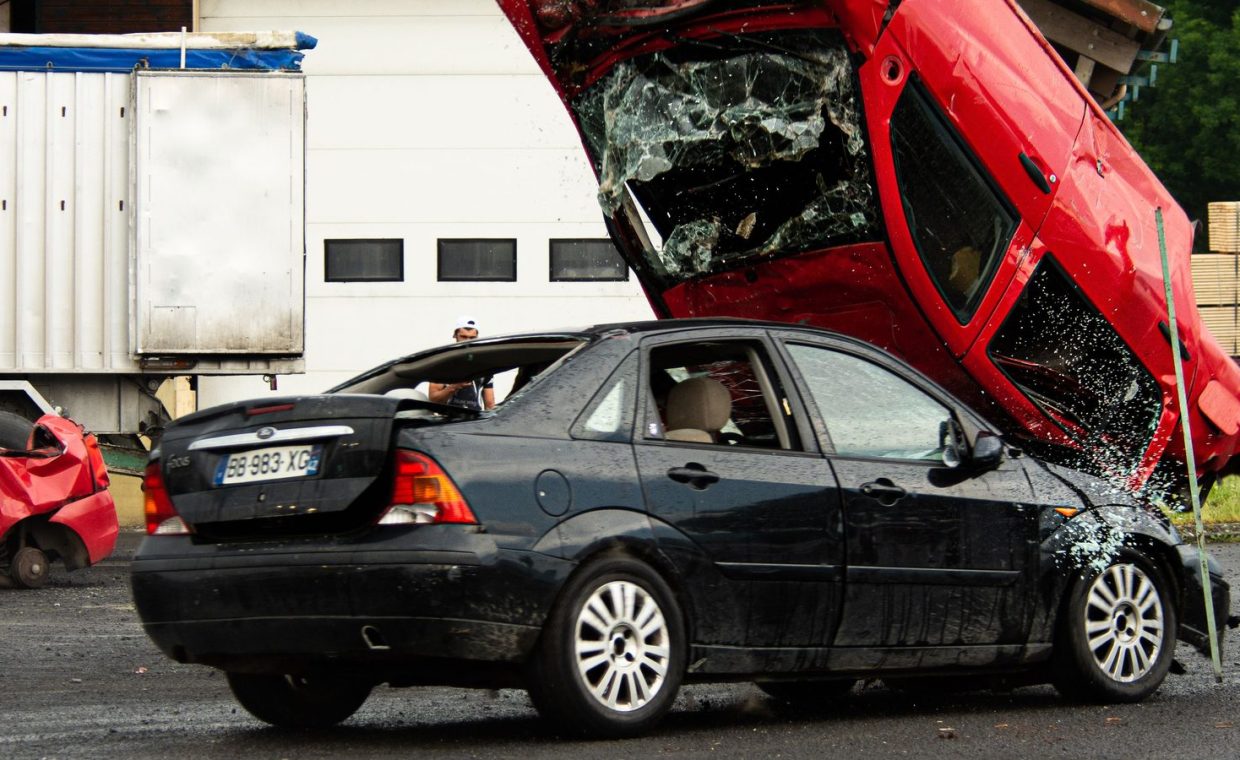
This one is not a feature you tick on a form, but it is the single biggest factor in whether you walk away. Underneath the sheet metal is a cage of high-strength steel designed to keep its shape around you while everything ahead of you crumples and absorbs energy.
Engineers call the cabin the "safety cell." The hood, fenders, and front rails are sacrificial. They fold up like an accordion on purpose, stretching the moment of impact from a violent instant into a few extra milliseconds. Those milliseconds are what keep the forces on your body survivable.
You can't option this, but you can shop for it. Look up a model's crash-test ratings before you buy, and pay special attention to the small-overlap front test, which is the brutal corner-of-the-bumper hit that older designs handled badly. A strong cage with weak ratings in that test is still a weak car for the way crashes actually land.
3. Side and Curtain Airbags
Front airbags get all the attention, but the side of your car is where you are most exposed. There is barely a foot of door between your ribs and another vehicle, and side impacts are responsible for a large share of serious injuries.
Curtain airbags drop down from the roofline to shield your head, and side torso bags push out from the seat to protect your chest and pelvis. In a T-bone at an intersection, these are the difference between a bad bruise and a hospital stay.
Most new cars include them, but coverage varies. Some bargain trims protect the front seats and skip the rear. If you regularly carry kids or passengers back there, confirm the curtains run the full length of the cabin, not just row one.
Ask to see the airbag locations stamped near the headliner and seats. You'll often spot small "SRS Airbag" labels on the pillars. No rear label usually means no rear curtain coverage.
4. Electronic Stability Control
Electronic stability control (ESC) belongs in the "prevents the crash" tier alongside AEB, and it has quietly saved more lives than almost any other feature of the last 30 years. It works by braking individual wheels when it senses you starting to skid or spin.
Picture my friend on that icy ramp. ESC is the system fighting to keep the back end from swinging around when traction disappears. It cannot beat physics, but it buys you control right at the edge, which is exactly where panic usually takes over.
The good news: ESC has been required on new cars in most markets for over a decade, so any recent model has it. The thing to watch is on used cars from the mid-2000s and earlier, where it might be missing or optional. On a winter-state used lot, I would not buy without it.
5. A Strong, Well-Designed Seatbelt System
I know, a seatbelt sounds too basic to rank. But the modern belt is a serious piece of engineering, and the differences between a good system and a cheap one show up clearly in the crash data.
Look for two things. Pretensioners yank the slack out of the belt the instant a crash begins, pinning you back into the seat before you load up the airbag. Load limiters then let the belt give a controlled inch or two so it does not crack your collarbone or ribs under full force.
Together with the airbag, a good belt system is choreographed down to the millisecond. The airbag is tuned assuming you are belted and held in place. Ride unbelted and you arrive at the bag too fast and at the wrong angle, which is how a safety device turns into an injury.
Those clips that fool the seatbelt chime are one of the worst things you can buy for a car. They disable the entire choreography I just described and turn the airbag into a hazard. Just click the belt.
6. A Blind-Spot Monitor That Earns Its Keep
Blind-spot monitoring lives one tier below the heavy hitters, but it prevents a very common and very avoidable kind of crash: the lane-change sideswipe. A light glows in your mirror when a car is sitting where you cannot see it, and many systems chirp if you signal anyway.
What pushes this onto my list is the rear cross-traffic version. Backing out of a tight parking spot between two SUVs, you are blind to anything coming down the lane. The sensors catch it before you do, and that one alert has saved more bumpers and pedestrians than people give it credit for.
Here is a small ownership note. These sensors live behind the rear bumper, so a fender-bender repair or a cheap aftermarket paint job can knock them out of calibration. If the light stops behaving after bodywork, get it checked rather than ignoring it.
7. Driver Attention and Drowsiness Monitoring
This is the newest item here, and it ranks last not because it is weak but because it is the most preventive and the least dramatic. Cameras or steering inputs watch for the signs that you are tired or distracted, then nudge you with a coffee-cup icon or a chime to pull over.
Fatigue crashes are ugly precisely because there is no braking and no swerving. The driver is simply gone for a second or two. A system that catches the early drift and wakes you up is stopping a crash before it has any chance to start.
It pairs naturally with how we use our cars now. If your phone is mirrored and you have your routes and music sorted before you roll, as I lay out in our guide to getting wireless CarPlay and Android Auto running cleanly, you are not fumbling with a screen at 70 mph in the first place. The tech and the habit reinforce each other.
How to Read the Option Sheet
When you are standing in the showroom, the trick is to separate the crash-avoidance features from the crash-survival features and make sure you have at least the heavy hitters from each.
| Feature | What it does | Priority |
|---|---|---|
| Automatic emergency braking | Stops the car when you don't | Must-have |
| Strong crash structure | Keeps the cabin intact | Must-have |
| Side and curtain airbags | Protect head and chest in T-bones | Must-have |
| Electronic stability control | Stops skids and spins | Must-have |
| Modern seatbelt system | Holds you in the right spot | Must-have |
| Blind-spot monitoring | Prevents sideswipes | Strongly nice |
| Attention monitoring | Catches fatigue and distraction | Nice to have |
One last buying note that has nothing and everything to do with safety. Don't let a heavily loaded safety package quietly eat your whole budget if it means buying a car that doesn't fit your real driving. An EV that comes up short on its honest mileage, the kind of gap we measure in our look at which EVs actually deliver their rated range, can leave you rushing and cutting corners on long trips, and a hurried, tired driver undoes a lot of expensive sensors.
Prioritize automatic emergency braking, a strong crash structure, full airbag coverage, stability control, and a modern belt system. Treat blind-spot and attention monitoring as welcome additions, not the reason you buy.
Is a car with more airbags always safer?
Not by itself. Airbag count matters less than coverage and a strong crash structure to fire them into. A car with full-length curtain airbags and a high small-overlap rating beats one that just stuffs a high airbag number onto a weak body.
Can I add these safety features to an older car?
Mostly no. Airbags, crash structure, stability control, and AEB are engineered into the vehicle and cannot be retrofitted in any meaningful way. A few aftermarket blind-spot kits and dash cameras exist, but the features that matter most in a crash come built in or not at all.
Do these systems make insurance cheaper?
Often a little, especially automatic emergency braking and blind-spot monitoring, because they cut the small collisions insurers pay out on constantly. The discount varies by company and region, so it is worth asking, but think of it as a bonus rather than the reason to choose them.
So before you sign anything, do the three checks that the option sheet will never spell out for you. Pull the small-overlap crash rating, run your finger along the rear pillars for a curtain-airbag label, and ask the salesperson to confirm the car has automatic emergency braking standard, not buried in a thousand-dollar bundle. My friend from that icy ramp did none of those things and got lucky once. The next buyer who reads this can skip the luck and buy the structure instead.